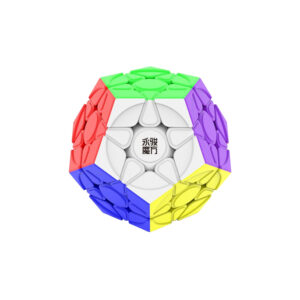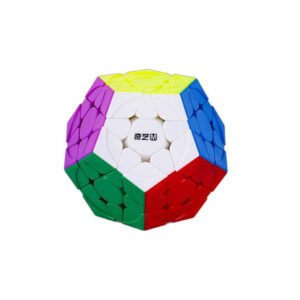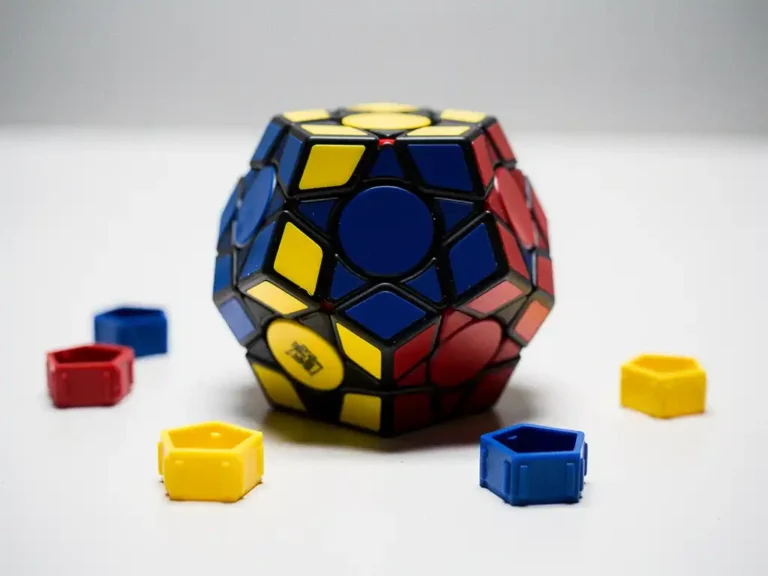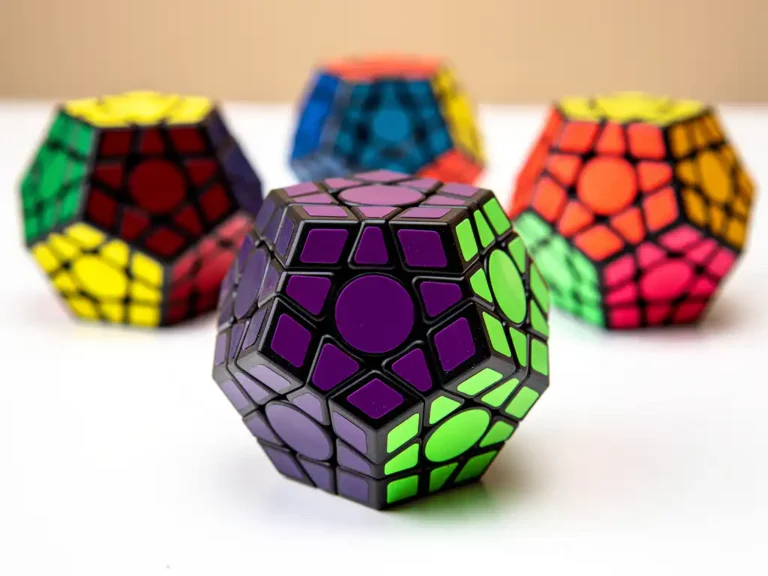
If you already have experience with the 3×3, you’ll recognize a large portion of these algorithms right away. In this article, we cover exactly which algorithms are essential, how to learn them as quickly as possible, and which approach requires the least effort.
How many algorithms do you need to solve the Megaminx?
To solve the Megaminx completely, you need an average of between 10 and 15 algorithms. The exact number depends on the method you choose, but most beginners do just fine with a compact set of around 12 algorithms. That’s comparable to solving a standard 3×3.
The Megaminx looks impressive with its 12 faces and 20 corner pieces, but its structure is very similar to that of a 3×3. Most methods solve the puzzle layer by layer, with the lower layers being relatively intuitive and only the last layer requiring a fixed set of algorithms. It’s reassuring for beginners to know that you don’t need to memorize hundreds of algorithms to solve the Megaminx.
Which algorithms are essential for the last layer of the Megaminx?
The essential algorithms for the last layer of the Megaminx are: orienting the corners (OLL corners), permuting the corners (PLL corners), orienting the edges, and permuting the edges. These are the same four phases as on the 3×3, but applied to a dodecahedron with five edges per face instead of four.
Specifically, these are the algorithms you truly need for the last layer:
- Sune and Anti-Sune for orienting corner pieces
- A T-perm or Y-perm for swapping corners
- A U-perm for cycling edges
- An algorithm for flipping edges in place
Many solvers also use a separate algorithm to orient multiple corners simultaneously in a single pass, which saves time. As long as you have this core set down, you can solve any Megaminx completely — even if multiple repetitions of the same algorithms are sometimes needed.
Can 3×3 algorithms be used on the Megaminx?
Yes, a large portion of 3×3 algorithms work directly on the Megaminx. Well-known algorithms such as Sune, Anti-Sune, the T-perm, and the U-perm are almost identically applicable, because the logic of corners and edges is the same on both puzzles. The biggest difference lies in the notation and the number of edges per layer.
On the Megaminx, you work with five edges per face instead of four, which means some algorithms feel slightly different in your hands. Even so, the transferability is significant: anyone who already knows the 3×3 has a considerable head start when learning the Megaminx. You really only need to learn the new moves specific to the pentagonal faces, such as rotating a full face with five edges at once. Experience with other puzzles like the Pyraminx or Mirror Cube also helps develop the spatial awareness that comes in handy on the Megaminx.
What is the best order to learn Megaminx algorithms?
The best order to learn Megaminx algorithms is: first solve the lower layers intuitively without algorithms, then tackle corner orientation on the last layer, followed by corner permutation, then edge orientation, and finally edge permutation. This progression follows the natural structure of the puzzle.
In practice, a good learning path looks like this:
- Learn to solve the first layer intuitively, including the white face and its edges
- Practice the middle layers using simple insertion algorithms you already know from the 3×3
- Add the Sune algorithm for corner orientation on the last layer
- Learn a permutation algorithm for the corners
- Finish with edge orientation and edge permutation
By following this order, you build confidence as you learn. You don’t need to memorize everything at once — instead, you add algorithms step by step as you progress through the solve.
How do you memorize Megaminx algorithms faster?
The fastest way to memorize Megaminx algorithms is to connect them to a visual pattern rather than a sequence of isolated moves. Always look at what an algorithm does to the pieces on the puzzle, and give that pattern a name in your head. Short practice sessions of five to ten minutes are more effective than one long memorization session.
Practical tips for learning algorithms faster:
- Practice each new algorithm at least ten times in a row before moving on
- Say the moves out loud as you perform them — this reinforces memory
- Learn algorithms in pairs, such as Sune and Anti-Sune, so you see them as mirror images of each other
- Use a timer to track your progress, even if you’re still going slowly
- Watch solve videos and compare the moves to your own execution
It also helps to pick up the Megaminx every day, even if it’s just for a few minutes. Consistency beats intensity when it comes to building muscle memory.
Which method requires the fewest algorithms for the Megaminx?
The LBL method (layer-by-layer) requires the fewest algorithms for the Megaminx and is the most accessible approach for beginners. With this method, you can get by with around 10 to 12 algorithms. Advanced methods such as Ortega or Yau require more algorithms but are faster to execute.
The LBL method solves the Megaminx by completing each layer fully before moving on to the next. That sounds straightforward — and it is. Most steps are intuitive or based on algorithms you already know from the 3×3. Only the last layer calls for a fixed set of algorithms, and even those are largely familiar to anyone who has solved a cube before.
If you eventually want to get faster, it’s worth switching to a method with more algorithms but more efficient moves later on. But for anyone solving the Megaminx for the first time, LBL is by far the most logical starting point. At Speedcube.nl, we always recommend mastering the basics completely before diving into more complex methods.
Frequently asked questions
How long does it take on average to get comfortable with all Megaminx algorithms?
Most beginners need between two and four weeks to comfortably master a basic set of 10 to 12 algorithms, provided they practice for about fifteen minutes every day. The first algorithm takes the most time; after that, learning new algorithms gets progressively faster because you’re already familiar with the movements of the Megaminx. Don’t expect to have the algorithms down perfectly after one session — repetition over multiple days is what truly locks them into muscle memory.
What are common mistakes when learning Megaminx algorithms?
The most common mistake is trying to learn too many algorithms at once too quickly, causing them to blur together in your memory. Another pitfall is learning algorithms purely by rote without understanding what they do to the pieces on the puzzle — this makes you forget them faster and makes it harder to correct yourself when you make a mistake. Start with one algorithm, practice it until it becomes automatic, and only then add a new algorithm to your repertoire.
Can I learn to solve the Megaminx without knowing the 3×3?
Yes, it’s certainly possible, but it’s considerably harder because you have no frame of reference for the algorithms or the logic behind layer-by-layer solving. If you haven’t mastered the 3×3 yet, we recommend starting there first — you’ll learn the fundamental principles faster on a cube and can then apply that knowledge directly to the Megaminx. The investment in the 3×3 pays off twice over once you start on the Megaminx.
What should I do if an algorithm doesn't give the expected result mid-solve?
This is almost always the result of an incorrect starting position: the algorithm itself is right, but you applied it in the wrong place or the wrong orientation. Reset the Megaminx to the point before the algorithm and check whether the pieces you want to affect are in the correct position. It helps to choose one reference piece per algorithm to use as an anchor for recognizing the correct starting position before you begin.
Are there good online resources or apps for practicing Megaminx algorithms?
For learning algorithms, websites like SpeedSolving.com and the YouTube channel of J Perm are excellent free resources with visual explanations specifically for the Megaminx. The app CubeX also offers a visual solver that lets you see how algorithms work on the puzzle. If you want to track your times and challenge yourself, cstimer.net is a popular choice among speedcubers of all levels.
When does it make sense to switch from LBL to a faster method like Ortega?
It’s worth switching to a more advanced method once you can consistently solve the Megaminx with LBL and your average solve time has stabilized — aim for an average under ten minutes as a benchmark. At that point, you’ll start to feel the inefficiencies of LBL, and your puzzle intuition will be strong enough to pick up more algorithms quickly. Don’t switch before then: a solid LBL foundation makes learning any subsequent method considerably easier.
Does it matter which Megaminx I buy when I'm just starting to learn algorithms?
Yes, the quality of the puzzle directly affects your learning process: a stiff or catching Megaminx makes executing algorithms more frustrating and slower. For beginners, an entry-level model from a reputable brand like X-Man or MoYu is more than sufficient — these turn smoothly enough to practice algorithms comfortably without needing a competition-grade puzzle right away. A good puzzle lowers the barrier to entry and keeps you motivated, especially during the first few weeks.