
-
 Dave Vinke
- Leestijd: 5 min
- Laatst geüpdatet: 26/03/2026

The Rubik’s Cube is one of the most iconic puzzles in the world and has fascinated puzzle enthusiasts for more than four decades. This colorful three-dimensional puzzle, invented by Hungarian architect Ernő Rubik in 1974, has evolved from an educational tool into a global phenomenon.
Whether you’re a curious beginner holding a Rubik’s Cube for the first time, or someone considering getting serious about speedcubing, understanding the basics is essential. In this article, we answer the most frequently asked questions about this fascinating puzzle.
What exactly is a Rubik’s Cube?
A Rubik’s Cube is a three-dimensional puzzle consisting of a 3×3×3 cube with six sides, each covered with nine colored squares. The goal is to make all sides of the cube one color by rotating the different layers. The standard colors are white, yellow, red, orange, blue, and green.
The cube consists of 26 smaller cubes, also called “cubies,” which are interconnected by an ingenious mechanism. The center piece of each side always stays in the same place and determines the color of that side. The corner pieces have three visible faces and the edge pieces have two visible faces.
What makes the Rubik’s Cube so fascinating is the enormous number of possible combinations: more than 43 trillion different positions. Yet from any random position, a solution is always possible, usually in 20 moves or fewer.
How does a Rubik’s Cube actually work?
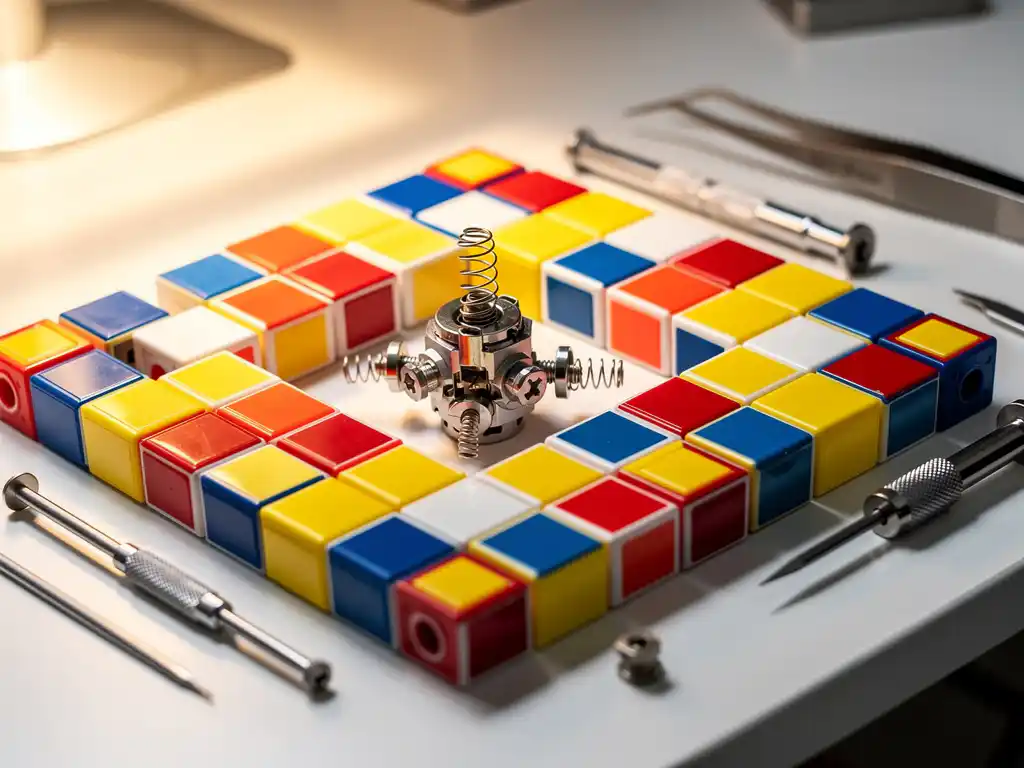
A Rubik’s Cube works through a central cross mechanism that connects all layers together. When you rotate a layer, the pieces move along rails and slide to new positions while remaining connected to the whole.
The internal mechanism consists of a three-dimensional cross with six arms extending outward. The center pieces are attached to these arms and never change position. The corner and edge pieces glide along this structure when you rotate the layers.
Each turn moves multiple pieces simultaneously in a predictable pattern. This makes it possible to develop algorithms: specific sequences of turning movements that have certain effects on the cube. These algorithms form the basis for all solving methods, from beginner to advanced level.
What is the difference between a regular cube and a speedcube?
The main difference between a regular Rubik’s Cube and a speedcube lies in turning speed, smoothness, and adjustability. Speedcubes are specially designed for fast solving and often contain magnets, adjustable tension, and advanced lubrication systems for optimal performance.
Regular Rubik’s Cubes, like the original design, often have stiffer mechanisms and can jam during fast movements. They’re perfect for casual use but can be frustrating for people who want to practice seriously. Speedcubes, on the other hand, are optimized for smooth, fast turning movements.
Modern speedcubes feature magnetic positioning that helps align the layers, adjustable tension for personal preference, and high-quality plastics that are more durable. They also have better corner cutting: the ability to turn through even when layers aren’t perfectly aligned.
How do you solve a Rubik’s Cube as a beginner?
As a beginner, you can solve a Rubik’s Cube using the layer method: you solve the cube layer by layer, starting with a white cross, followed by the white corners, the middle layer, a yellow cross, and finally the last layer. This method requires learning about five to seven basic algorithms.
Start by making a white cross on the bottom, with the edge pieces also correctly aligned with the center pieces of the sides. Then place the white corner pieces to complete the first layer. These steps mainly require logical thinking and no specific algorithms.
For the middle layer, you use your first real algorithms to get the edge pieces in the right place. Then you make a yellow cross on top, orient all yellow pieces correctly, and finally position all pieces of the last layer in the right place.
Learning this method usually takes several days to weeks, depending on your practice time. Once you’ve mastered the method, you can consistently solve the cube in one to three minutes.
Which Rubik’s Cube is best for beginners?
For beginners, an entry-level speedcube with magnetic positioning and smooth turning movements is best, such as the MoYu RS3M or QiYi Warrior W. These cubes are affordable, user-friendly, and grow with you as your skills improve, without the frustrations of a traditional, stiff cube.
Avoid overly cheap unbranded cubes, as they often turn poorly and can hinder your learning process. A cube that jams or turns with difficulty makes solving unnecessarily frustrating. It’s better to invest in a quality entry-level model that will last for years.
It’s also important that the cube isn’t set too loose. Some speedcubes are so smooth that beginners find them difficult to control. Look for a cube with moderate tension that feels stable but still turns smoothly.
Also consider starting with a cube that’s already well-tuned and lubricated. This saves you the trouble of optimizing it yourself and ensures you can start learning to solve immediately, rather than tinkering with the hardware.
Frequently Asked Questions
How long does it take to solve your first Rubik's Cube?
For most beginners, it takes 2-4 weeks of regular practice (15-30 minutes per day) to master the layer method. Your first successful solve may take 10-20 minutes, but this quickly improves to 2-5 minutes as you better memorize the algorithms.
What if my cube falls apart during solving?
If your cube falls apart, you can usually easily reassemble it by first reconstructing the central mechanism and then placing the pieces back one by one. Start with the center pieces, followed by the edge pieces and finally the corner pieces. Pay attention to the correct orientation of each piece.
Can I solve a Rubik's Cube without learning algorithms?
While it's theoretically possible to solve intuitively, learning basic algorithms is much more efficient and faster. The layer method requires only 5-7 simple algorithms that you can learn within a few days. Without algorithms, solving can take hours and be very frustrating.
How do I maintain my speedcube for optimal performance?
Lubricate your speedcube every 1-2 months with silicone spray or special cube lubricants, depending on your usage frequency. Clean the cube regularly by taking it apart and removing dust and dirt. Adjust the tension if the cube feels too loose or too tight by turning the screws on the center pieces.
What are the most common mistakes beginners make?
The biggest mistakes are: turning too hard causing the cube to jam, not executing algorithms correctly due to haste, and trying to go too fast before the basics are solid. Focus first on accuracy and smooth movements; speed comes naturally as you practice more.
When should I switch to more advanced solving methods?
Consider advanced methods like CFOP or Roux when you can consistently solve under 60 seconds with the layer method. This usually happens after 2-6 months of regular practice. Then start learning two-look OLL and PLL to further improve your times to 20-30 seconds.
Are there apps or tools that can help with learning to solve?
Yes, apps like CubeX, Magic Cube Solver, and ChaoTimer are very useful. They offer step-by-step tutorials, algorithm trainers, and timers for tracking your progress. YouTube channels like J Perm and CubeSkills also offer excellent video tutorials for all levels.
Table of contents
Much viewed
More blogs