
-
 Dave Vinke
- Leestijd: 5 min
- Laatst geüpdatet: 05/01/2026

3D puzzles develop a broad range of cognitive skills that go far beyond simple entertainment. These three-dimensional challenges train your spatial awareness, problem-solving ability, and concentration in a unique way. From wooden building kits to complex model construction projects, every 3D puzzle helps your brain develop new thinking patterns that are useful in daily life.
What is the difference between 3D puzzles and regular puzzles for your brain?
3D puzzles activate different brain areas than flat jigsaw puzzles because they require spatial thinking and three-dimensional visualization. While regular puzzles mainly use pattern recognition and color recognition, with 3D puzzles you must constantly assess the shape and position of components in space.
The fundamental difference lies in the complexity of the mental processes. With a traditional jigsaw puzzle, you work primarily with two dimensions and visual cues like colors and lines. 3D puzzles, on the other hand, ask you to understand how different components fit together from multiple angles simultaneously.
This three-dimensional challenge activates the parietal lobe of your brain, the area responsible for spatial processing. This explains why people who are good at 3D puzzles often also excel in subjects like mathematics, engineering, and architecture. You learn to mentally rotate objects and understand their relationships to each other.
Which cognitive skills do you develop by regularly doing 3D puzzles?
Regular 3D puzzling strengthens five core skills: spatial awareness, logical reasoning, pattern recognition, working memory, and visual-motor coordination. These skills build upon each other and become stronger as you tackle more challenging puzzles.
Spatial awareness is perhaps the most notable skill you develop. You learn to visualize and manipulate three-dimensional objects in your mind. This helps not only with puzzles, but also with practical tasks like packing a suitcase or understanding technical drawings.
Working memory gets a solid workout because you must hold multiple puzzle pieces and their possible positions in your mind simultaneously. Logical reasoning develops because you must systematically figure out which pieces belong where and in what order you should place them.
Pattern recognition becomes more refined because you learn to distinguish subtle differences in shape and structure. This skill is particularly valuable with more complex wooden 3D puzzle projects, where small details make the difference between success and frustration.
How do 3D puzzles improve your problem-solving ability in daily life?
3D puzzles teach you to think systematically, experiment patiently, and find creative solutions to complex problems. These strategies are directly applicable in work and study situations where you must approach challenges in a structured way.
The methodical approach you learn from puzzling is particularly valuable. You develop the ability to break down large problems into smaller, manageable parts. This is the same skill you need for project management, scientific research, or learning new skills.
3D puzzles also teach you to consider multiple solution routes before acting. This flexibility in thinking helps you in situations where the first approach doesn’t work and you must think of alternative strategies. The patience you develop when trying out different possibilities is essential for innovative thinking.
The skill of recognizing patterns and connections that you develop through puzzling also helps you analyze complex information in your work or studies. You learn to see the underlying structure of problems, allowing you to devise more effective solutions.
Why do 3D puzzles help develop patience and concentration?
3D puzzles require prolonged focus and mental discipline because you cannot rush through the process. Each piece must be carefully placed, which naturally develops patience and sustained attention that is transferable to other activities.
The step-by-step nature of 3D puzzling trains your brain to stay focused on a task, even when the result is not yet visible. This skill is incredibly valuable in our time of constant distraction from smartphones and social media.
The satisfaction you feel when a puzzle piece fits perfectly activates the reward system in your brain. This creates a positive association with patient, concentrated work. You learn to enjoy the process itself, not just the end result.
3D puzzles also teach you to handle frustration constructively. When something doesn’t work immediately, you develop the habit of taking a step back, looking at the situation again, and trying a different approach. This emotional regulation is essential for success in both personal and professional situations.
Which 3D puzzles are best to start with for maximum skill development?
Beginners should start with simple wooden 3D puzzles or basic 3D building kits of 20-50 components. These offer sufficient challenge without being overwhelming and let you develop fundamental skills.
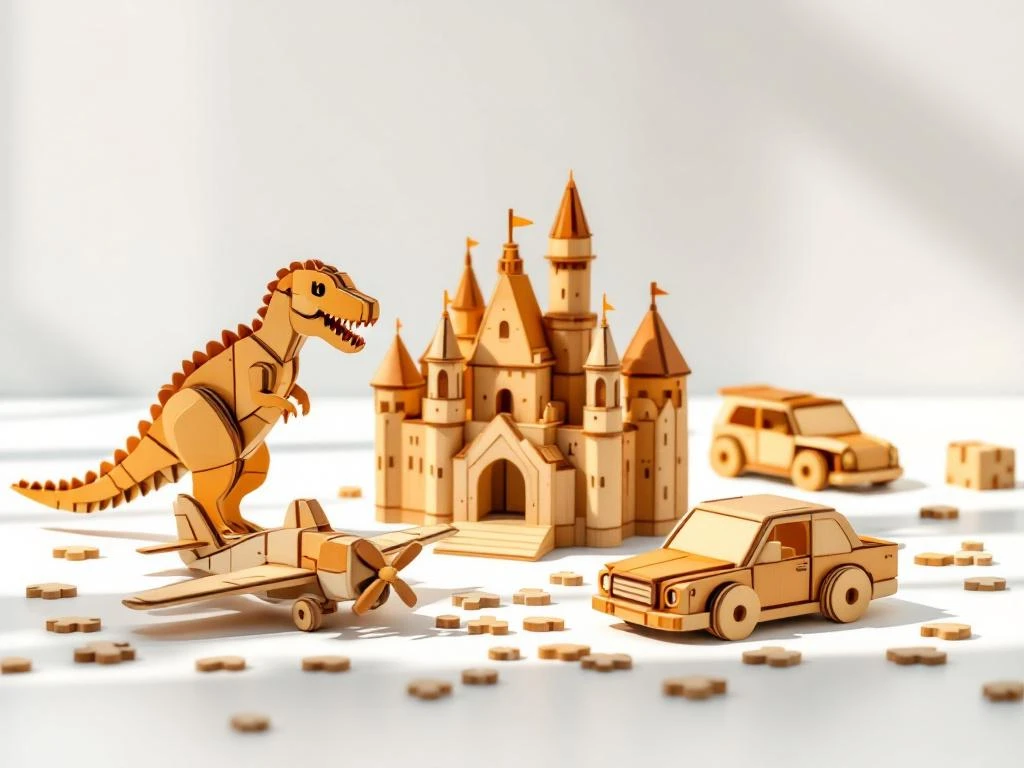
Wooden 3D puzzles are ideal for beginners because the pieces are sturdy and clearly defined. They often have a logical building sequence that helps you develop systematic thinking. Start with simple shapes like animals or vehicles before moving on to more complex architectural models.
3D building kits form a good next step because they require more precision and often combine multiple materials. They teach you to follow instructions carefully while developing spatial awareness.
For optimal skill development, it’s important to gradually increase the difficulty level. Start with puzzles you can complete in one session and work up to projects that require multiple days or weeks. In our extensive range of 3D puzzles, you’ll find suitable challenges for every level, from beginner projects to expert models that really put your skills to the test.
3D puzzles offer a unique combination of entertainment and cognitive training that helps you develop essential thinking skills. Whether you choose wooden puzzles or complex building kits, each project contributes to your mental flexibility and problem-solving ability. Start with a level that suits you and experience for yourself how this fascinating hobby strengthens your thinking ability.
Frequently Asked Questions
How long does it take before you notice improvement in your cognitive skills?
Most people notice improvements in their concentration and spatial awareness after 2-3 weeks of regular puzzling. Significant progress in problem-solving ability usually becomes visible after 1-2 months of consistent practice. The key is to spend at least 15-30 minutes per day on 3D puzzles for optimal results.
What should you do if you get stuck on a difficult 3D puzzle?
Take a break of at least 30 minutes to reset your brain. Look at the puzzle from different angles and try a different building sequence. Sort all components again and look for patterns or groups that belong together. If you're really stuck, consult the instructions for hints, but try to find a solution yourself first.
Can 3D puzzles also help with learning difficulties like dyslexia or ADHD?
Yes, 3D puzzles can work supportively with various learning difficulties. They help with ADHD by training focus and patience, and with dyslexia by strengthening spatial awareness which can help with recognizing letter shapes. However, it's important to choose puzzles that aren't too overwhelming and to build in regular breaks.
Which materials are best for durable 3D puzzles?
Wood is the best material for durability and tactile experience, especially birch or bamboo wood. Metal puzzles are very durable but can be more difficult for beginners. Avoid cheap plastic puzzles that break quickly. Quality wooden puzzles last for years and maintain their shape, allowing them to continue providing their challenge.
How often per week should you do 3D puzzles for optimal brain development?
For optimal cognitive benefits, 4-5 sessions per week of 20-45 minutes is ideal. This gives your brain sufficient stimulation without overload. Vary between different types of 3D puzzles to activate different brain areas. Consistency is more important than long sessions - better 20 minutes daily than once per week for 3 hours.
Can adults still achieve significant cognitive benefits from 3D puzzles?
Absolutely! Adult brains remain plastic and can form new neural connections. 3D puzzles are even particularly valuable for adults because they help maintain cognitive sharpness and can contribute to preventing mental decline. Start with challenges that match your current level and build up gradually.
What are common mistakes when starting with 3D puzzles?
The biggest mistake is starting with puzzles that are too difficult, which leads to frustration. Other mistakes are: not sorting all components first, wanting to go too fast without reading the instructions, and giving up at the first setbacks. Always start with puzzles of 20-50 components and take time to look at each piece carefully before placing it.
Table of contents
Much viewed



More blogs