
-
 Dave Vinke
- Leestijd: 5 min
- Laatst geüpdatet: 05/01/2026

Teaching a child to puzzle begins with choosing the right puzzle for their age and creating a positive, supportive environment. Start with simple puzzles and gradually build up to more complex challenges. Patience and encouragement are essential to prevent frustration and maintain the joy of puzzling.
Why is puzzling so important for children’s development?
Puzzling supports children’s cognitive development by strengthening problem-solving thinking, spatial insight, and concentration ability. It also improves fine motor skills and hand-eye coordination, while developing patience and perseverance.
The benefits of puzzling extend across various developmental areas. Cognitively, children learn to recognize patterns, reason logically, and systematically approach problems. Their memory is trained by remembering shapes, colors, and where pieces belong.
Motorically, children develop precision in their hand movements and improve their ability to manipulate small objects. This is especially important for later skills like writing and drawing.
Emotionally, puzzling builds self-confidence when children successfully complete a puzzle. It teaches them to cope with frustration and show perseverance when something doesn’t work immediately. These skills are valuable for their overall development and future challenges.
At what age is it best to start puzzling?
Children can start with simple shape puzzles and insert puzzles from 12 to 18 months. Toddlers aged 2 to 3 years are ready for puzzles with 4 to 12 pieces, while preschoolers aged 4 to 5 years can handle puzzles of 20 to 60 pieces.
For the very youngest, thick wooden puzzles with large pieces are ideal. These children’s puzzles often have knobs or large handles that allow toddlers to easily pick up the pieces. Simple shapes like circles, squares, and triangles help them understand basic concepts.
Between 3 and 4 years old, children can move on to puzzles with more pieces. Puzzles with recognizable images like animals, vehicles, or familiar characters hold their interest. A wooden puzzle is still a good choice at this age because of durability and safety.
School-age children from 6 years old can handle more challenging puzzles with 100 pieces or more. At this age, they can also start with specialized puzzles, such as 3D puzzles or puzzles with special themes that align with their interests.
Which puzzles are most suitable for beginners?
Beginners benefit most from puzzles with large pieces, clear images, and a limited number of parts. Choose puzzles with bright colors, recognizable shapes, and a difficulty level that matches the child’s age.
For the youngest beginners, insert puzzles with thick wooden pieces are perfect. These often have only 3 to 6 pieces and show simple images. Puzzles with knobs or handles make it easier for small hands to grab and place pieces.
Jigsaw puzzles for beginners should have no more than 12 to 24 pieces. Look for puzzles with clear lines between pieces and images that interest the child. Animals, vehicles, and everyday objects are popular choices that help children make connections.
When choosing, pay attention to the quality of the material. A good wooden puzzle lasts long and is safe for children. Avoid puzzles with parts that are too small for young children and check that the puzzle meets safety standards.
How do you help a child who becomes frustrated during puzzling?
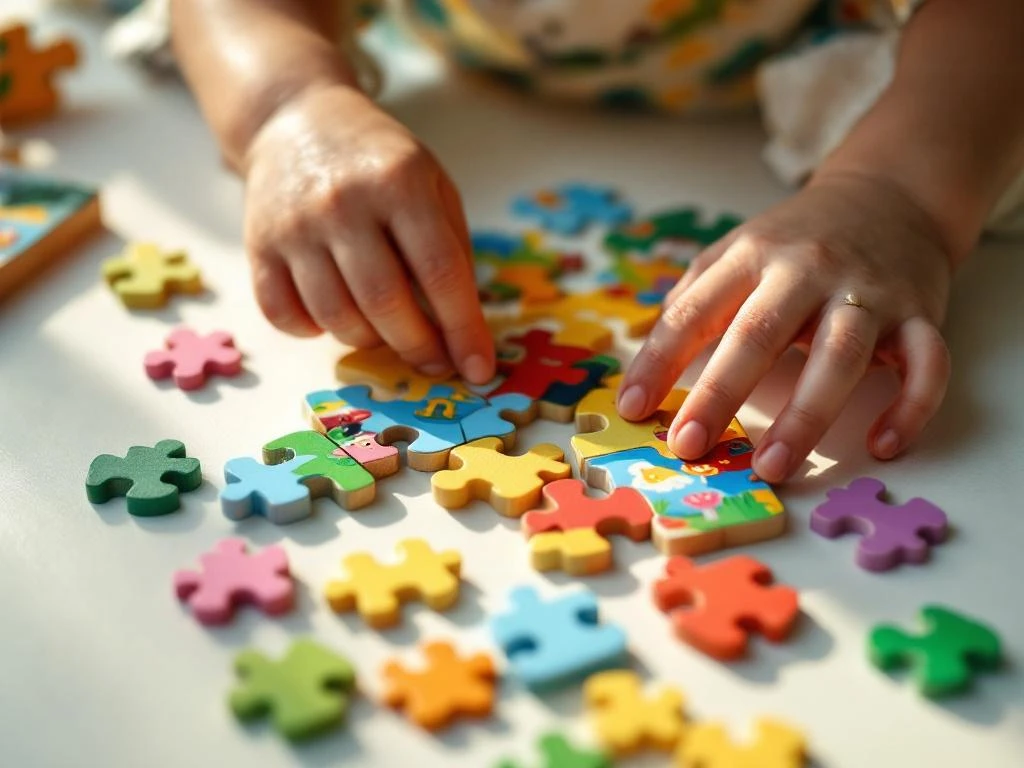
When a child becomes frustrated, offer emotional support without taking over the puzzle. Encourage small successes, help with strategies like sorting edge pieces, and take breaks when needed to relieve tension.
Recognize signs of frustration early. When a child sighs, throws pieces away, or gets angry, it’s time to intervene. Stay calm and understanding, and validate their feelings by saying that puzzling can sometimes be difficult.
Help with practical strategies without taking over the work. Teach them to look for edge pieces, sort colors, or look for patterns. Give hints by pointing to shapes or colors that might fit, but let them place the pieces themselves.
Make breaks a normal part of puzzling. Explain that it’s okay to stop for a while and continue later. This prevents puzzling from becoming a negative experience and keeps the fun in it.
What can you do if your child shows no interest in puzzling?
Try alternative puzzle types that better align with your child’s interests, such as 3D puzzles, magnetic puzzles, or digital puzzle apps. Make puzzling social by puzzling together and show that it can be fun without applying pressure.
Discover what your child is interested in and look for puzzles that connect to that. Does he love cars? Then look for vehicle puzzles. Is she crazy about princesses? Then there are plenty of fairy tale puzzles available. By connecting to their natural interests, puzzling becomes more relevant.
Experiment with different formats and materials. Some children prefer magnetic puzzles, while others find sliding puzzles or 3D puzzles more interesting. Adult puzzles with beautiful landscapes can appeal to older children who feel too grown-up for “children’s puzzles.”
Make it a social activity by puzzling together. Show that you enjoy it yourself and celebrate small victories together. Never force it, but regularly offer opportunities to make a puzzle together.
Where do you find the best educational puzzles for children?
Look for puzzles from quality brands that use safe materials, have clear images, and offer educational value. Check for safety certificates, read reviews from other parents, and choose suppliers who specialize in educational toys.
Quality criteria for good puzzles include sturdy construction, non-toxic materials, and age-appropriate difficulty levels. Look for puzzles that meet European safety standards and have clear age recommendations.
A reliable supplier offers comprehensive product information, has good customer service, and stands behind the quality of their products. They can advise on which puzzle best fits your child’s developmental stage.
When selecting puzzles, it’s important to look at the balance between challenge and enjoyment. A good puzzle specialist helps you make the right choice and offers both traditional wooden puzzles and modern alternatives that perfectly match your child’s interests and level.
Puzzling is a valuable activity that helps children grow in many areas. By choosing the right puzzle, patiently guiding your child, and creating a positive atmosphere, you lay the foundation for a lifelong love of puzzling and problem-solving.
Frequently Asked Questions
How long should a puzzle session last for a child?
For toddlers aged 2-3 years, sessions of 10-15 minutes are ideal, while preschoolers aged 4-5 years can usually concentrate for 20-30 minutes. School-age children can often puzzle for 45 minutes to an hour. Always watch for signs of fatigue and stop before frustration sets in.
What do you do if your child puts puzzle pieces in their mouth?
Always choose puzzles with large pieces that cannot be swallowed and supervise during play. For children under 3 years, wooden puzzles with extra large pieces are safest. Teach your child that puzzle pieces don't belong in the mouth and offer alternatives like teething rings if they need to chew.
Should you help your child or let them figure it out themselves?
Offer guidance without taking over. Help with strategies like looking for edge pieces or sorting by color, but let your child place the pieces themselves. Give hints by pointing to shapes or colors, but avoid solving it for them. This preserves their sense of ownership and success.
How do you know when your child is ready for a more difficult puzzle?
Your child is ready for more challenge when they can complete their current puzzle quickly and without help, show interest in more complex images, or ask for a 'grown-up puzzle' themselves. Gradually increase the number of pieces by about 50% and watch whether they stay motivated.
What are the best times to puzzle with your child?
Choose moments when your child is rested and alert, usually in the morning or after a nap. Avoid times just before meals when they're hungry, or late in the evening when they're getting tired. Make it a regular ritual, for example after breakfast or before bedtime reading.
How do you best store puzzles to avoid losing pieces?
Use sealed boxes or bags per puzzle and label them clearly. Create a fixed place where puzzles always return and teach your child this routine. For puzzles that are used regularly, you can use a puzzle mat where you can temporarily store the puzzle without breaking it apart.
Can puzzles help children with concentration problems?
Yes, puzzling can gradually improve concentration by providing short, successful experiences. Start with very simple puzzles that can be completed quickly to build confidence. Use a timer for short sessions and celebrate every completed puzzle, however small. Gradually build up to longer concentration periods.
Table of contents
Much viewed

More blogs