
-
 Dave Vinke
- Leestijd: 5 min
- Laatst geüpdatet: 05/01/2026

A falling 3D puzzle during construction can destroy hours of work and cause frustration. The best prevention starts with choosing a stable surface, using temporary support during critical building phases, and selecting a suitable work location without vibrations or disturbances. With the right preparation and techniques, you can safely build complex wooden 3D puzzles and other fragile constructions.
Why do 3D puzzles actually fall over during construction?
3D puzzles fall over due to a combination of physical factors that affect stability. The center of gravity shifts during construction, making the structure unstable. Materials like wood and plastic have different properties that determine sturdiness, and certain building phases make puzzles extra vulnerable to instability.
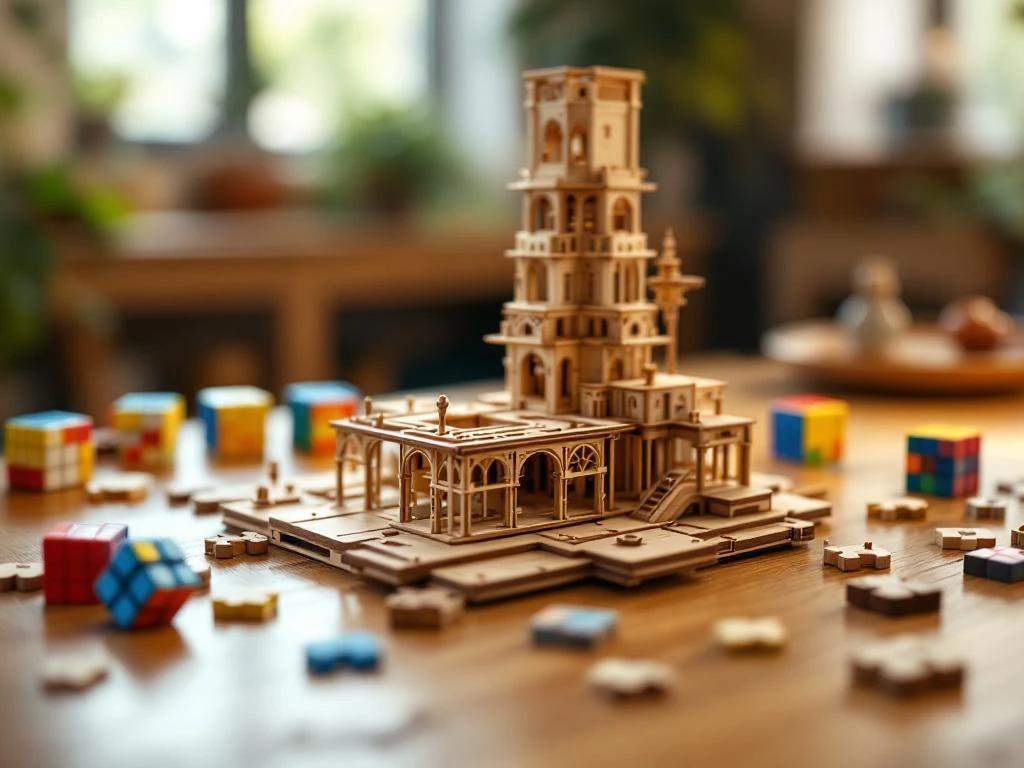
The center of gravity plays the biggest role in falling over. During construction, this point moves constantly as you add new components. With wooden 3D puzzles, this effect is more noticeable because wood is heavier than plastic. When you build at the top while the base is not yet completely sturdy, a top-heavy situation arises that causes instability.
Material properties make the difference in stability. Wood has natural variations in weight and density, which can create unpredictable centers of gravity. Plastic components are lighter but can be more flexible, making connections feel less sturdy. Metal components in 3D construction kits for model building offer more stability but can also be heavier on one side.
Critical building phases where puzzles are most vulnerable include the moment when you go from a flat base to a vertical construction, attaching protruding components like towers or wings, and the final phase where you complete the construction. These moments require extra attention and often temporary support.
Which surface offers the best stability for your 3D puzzle?
A sturdy, flat surface with sufficient grip prevents most falling behavior of 3D puzzles. A wooden table with a non-slip mat offers the best combination of stability and protection. The surface must be large enough to accommodate both the puzzle and your workspace, without bumping into the construction during building.
The texture of the work surface significantly affects grip. Smooth surfaces like glass or varnished wood allow puzzle components to slide away easily. A slightly rough texture, like untreated wood or a puzzle mat, provides better grip without damaging the components. Avoid surfaces that are too rough as they can cause scratches.
The hardness of the surface determines stability during construction. Surfaces that are too soft, like a bed or couch, absorb movements and make the construction unstable. Hard surfaces like a sturdy table or workbench provide the best foundation. A thin mat on a hard surface combines stability with protection.
The size of the work surface should be at least twice as large as the final puzzle. This provides space for components, instructions, and your arms without touching the construction. A workspace that is too small leads to unintended collisions that can cause the puzzle to fall over.
How can you temporarily support your 3D puzzle during construction?
Temporary support during critical building phases prevents falling and gives confidence when working on unstable sections. Use household items like books, boxes, or cushions as support around vulnerable parts. Professional solutions like model supports or adjustable clamps offer more precision but are not always necessary.
Household aids are often sufficient for simple support. Stack books around the base for extra stability, use small boxes as temporary support under protruding parts, or place soft cushions around the puzzle to prevent damage if it falls. Make sure these aids don’t touch the construction but do catch it if it moves.
Professional model supports are adjustable and reusable for different projects. You can position these small supports precisely where needed without disrupting the aesthetics of your project. Magnetic bases work well on metal work surfaces, while variants with suction cups are suitable for smooth surfaces.
Improvisation with tape and wire can help in specific situations. Use double-sided tape to temporarily secure loose components, or stretch thin wire between stable points as guidance. Be careful not to cause permanent damage to the puzzle with these methods.
What are the best locations to safely build your 3D puzzle?
A quiet room without foot traffic, vibrations, or airflow provides the safest environment for building 3D puzzles. Choose a location away from pets, small children, and busy walking routes. A dedicated hobby room or a quiet corner in the living room works best, provided you account for external factors that can affect stability.
Vibrations from traffic, washing machines, or music systems can subtly but constantly affect your puzzle. Test your work location by placing a glass of water and observing whether the surface moves during normal household activities. Move your workspace if you notice vibrations.
Airflow from fans, air conditioning, or open windows can move light puzzle components or destabilize an almost complete construction. Preferably work in a room where you can control air circulation. Close windows during critical building phases and turn off fans.
Pets and children pose unpredictable risk factors for your 3D puzzles. Cats are particularly curious about moving components, while dogs can trip over protruding constructions. Choose a work location that you can close off or elevate your workspace so that curious paws and hands cannot reach it.
By considering these factors and taking the right precautions, you can enjoy building complex 3D constructions without the frustration of fallen projects. The investment in a good workspace and support pays off in less stress and more building enjoyment.
Frequently Asked Questions
How do I know when my 3D puzzle becomes too unstable to continue building?
Watch for warning signs like vibrations with light touch, visible bending of components, or when the construction leans to one side. Stop building and add temporary support before continuing. A rule of thumb is that if you're afraid to touch the puzzle, it has become too unstable.
Can I still repair a fallen 3D puzzle without starting completely over?
Yes, you can often reuse sections that remained intact. First photograph the damage, carefully disassemble only the damaged parts, and check components for cracks before reusing them. Start the repair from the last stable point and reinforce weak connections extra.
Which tools help keep 3D puzzles stable during construction?
Basic tools are a non-slip mat, small clamps, adjustable model supports, and soft padding. For advanced builders, magnetic bases, precision tweezers for small components, and a rotating work table are useful. First invest in a good non-slip mat and model supports before purchasing more expensive tools.
How do I handle 3D puzzles that are naturally top-heavy due to their design?
Build top-heavy puzzles from bottom to top and work in phases where you fully stabilize each layer before continuing. Use a broader base than normal and consider temporary weights at the bottom. Plan extra time for these puzzles and never work hastily on critical connections.
What should I do if my workspace is limited but I still want to build large 3D puzzles?
Build in modular sections that you later combine, use a foldable work table that you can extend, or rotate the puzzle regularly to access all sides. Also consider working vertically with a rotating base, so you need less horizontal space.
How do I prevent dust and household activities from disturbing my 3D puzzle during long building projects?
Cover your project with a large box or transparent cover when you're not building. Choose a work location away from cooking activities and vacuuming. For projects that last weeks, consider a separate hobby room or a mobile work table that you can put away in a quiet room.
Is it normal that I get nervous as my 3D puzzle gets bigger?
Yes, this is completely normal and even wise - it shows you're aware of the risks. Channel this nervousness into extra precautions like better support and working more slowly. Take regular breaks to reduce tension and trust in your preparation and techniques.
Table of contents
Much viewed
More blogs