
-
 Dave Vinke
- Leestijd: 5 min
- Laatst geüpdatet: 04/01/2026

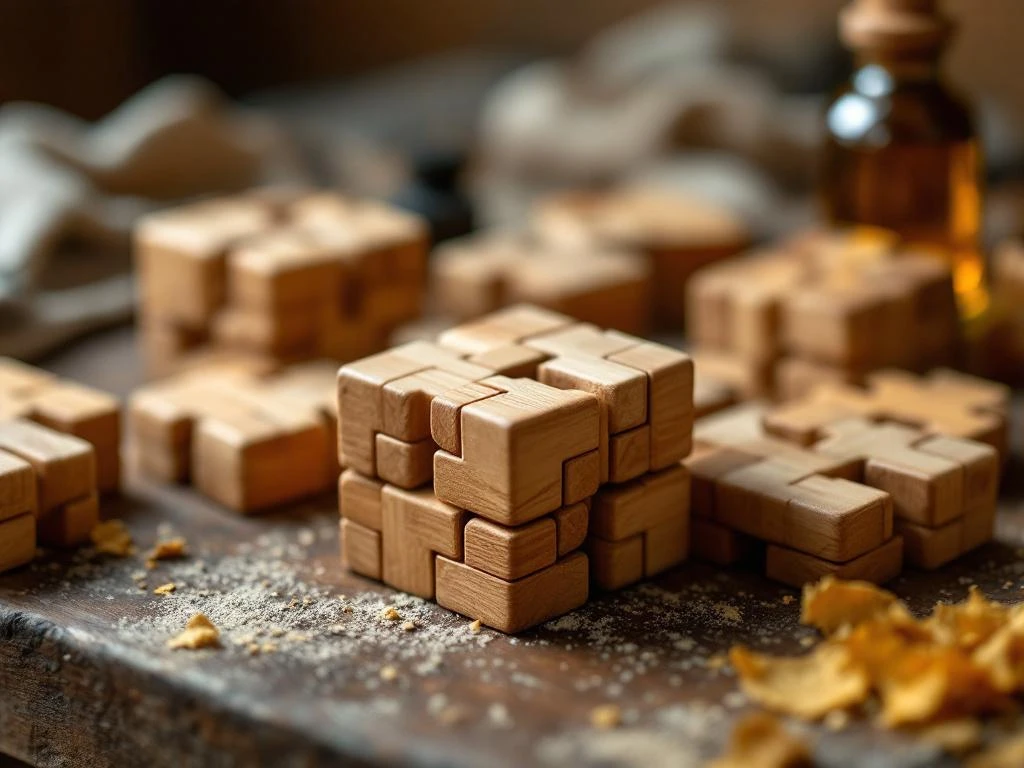
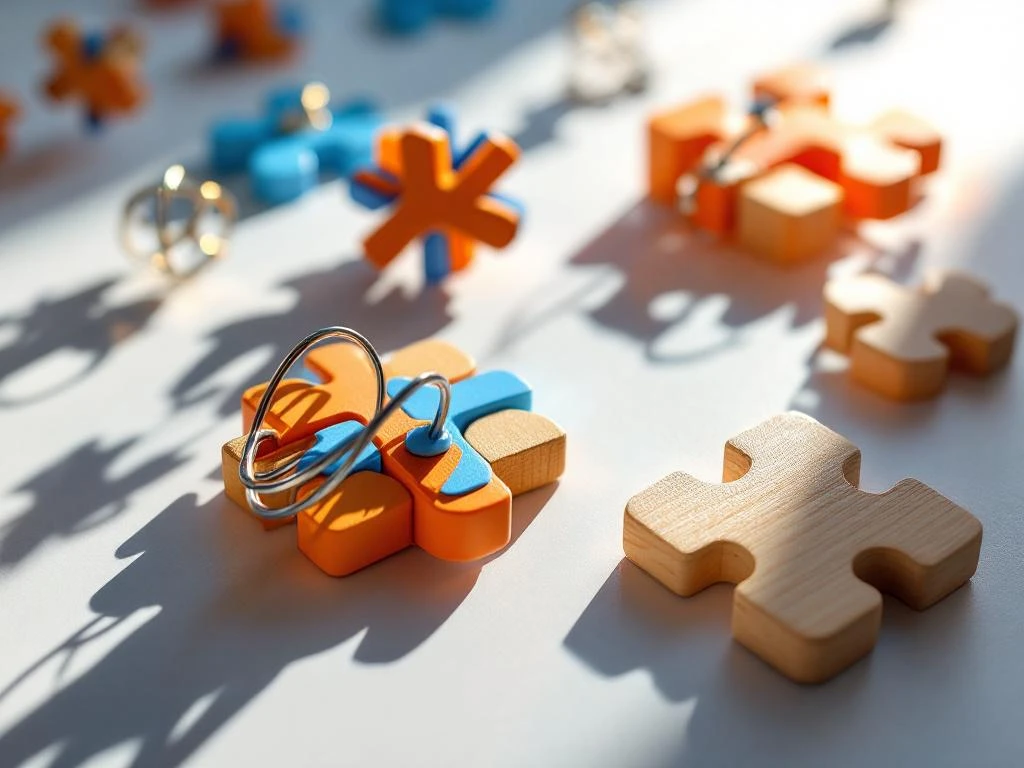
Brain teasers can be used by children from approximately 2 to 3 years old, depending on the type of puzzle and the child’s developmental level. Simple shape puzzles and stacking blocks are suitable for toddlers, while more complex mechanical brain teasers are better suited for children 6 years and older. The key lies in choosing the right difficulty level that offers challenge without causing frustration.
What are brain teasers and why are they important for children?
Brain teasers are puzzles and toys that challenge children to solve problems through logical thinking, spatial insight, and perseverance. They range from simple shape puzzles to complex mechanical puzzles like the Rubik’s Cube. These puzzles stimulate cognitive development by activating different brain areas simultaneously.
For children, brain teasers offer unique benefits that traditional toys cannot always provide. They develop problem-solving abilities by teaching children to systematically search for solutions. This process strengthens concentration, as children must stay focused to solve the puzzle.
The educational value of brain teasers lies in their ability to stimulate abstract thinking. Children learn to recognize patterns, understand cause and effect, and plan strategically. These skills are fundamental for later academic performance, especially in mathematics and natural sciences.
From what age can children use their first brain teasers?
Children can start with simple brain teasers like large stacking blocks, shape puzzles, and simple insert puzzles from as early as 2 to 3 years old. At this age, they develop their hand-eye coordination and learn basic shape and color recognition. Safety comes first, so choose puzzles without small parts.
Between 4 and 6 years old, children can handle more complex puzzles, such as jigsaw puzzles with 20 to 50 pieces, simple maze games, and tangram puzzles. Their attention span has become longer and they can understand multi-step processes. This is also the age when they may show interest in simple mechanical puzzles.
From 7 years and older, children are ready for real challenges, such as the 2×2 Rubik’s Cube, metal brain teasers, and more complex logical puzzles. Their abstract thinking ability is sufficiently developed to understand and apply strategies. Teenagers can tackle the standard 3×3 Rubik’s Cube and other advanced mechanical puzzles.
How do you choose the right difficulty level for your child?
The right difficulty level lies just above your child’s current level, so that it remains challenging without becoming overwhelming. Observe how your child reacts to puzzles: if they give up within a few minutes, the puzzle is too difficult. If it’s solved too quickly, it doesn’t provide sufficient mental stimulation.
Pay attention to your child’s frustration threshold. Some children enjoy long-lasting challenges, while others need quick moments of success. Always start with simpler variants and build up gradually. A child who struggles with a 2×2 cube is not yet ready for a 3×3 version.
Practical indicators for the right difficulty level are: your child stays focused for at least 10 to 15 minutes, shows signs of logical thinking, and experiences a sense of satisfaction when solving. If your child regularly asks for help but doesn’t give up, you’re probably at the right level.
What benefits do brain teasers offer for children’s development?
Brain teasers improve cognitive flexibility by teaching children to look at problems from different perspectives. They develop working memory, spatial insight, and pattern recognition. These skills are directly applicable in school subjects like mathematics, where logical thinking is essential.
Motorically, brain teasers improve fine motor skills and hand-eye coordination. Children learn precision and control over their movements, which also benefits writing skills and other practical activities. Bilateral coordination is stimulated when both hands work together.
Socially and emotionally, brain teasers build patience and perseverance. Children learn to deal with frustration and develop a growth mindset, where mistakes are part of the learning process. Successfully solving puzzles increases self-confidence and willingness to take on new challenges.
The concentration and focus that brain teasers require help children extend their attention span. In a time of constant digital stimuli, puzzles offer a valuable form of deep, uninterrupted concentration that is essential for effective learning.
Where can you find the best brain teasers for children?
High-quality, age-appropriate brain teasers can be found at specialized puzzle stores that have expertise in educational toys. Look for stores that provide clear age recommendations, show safety certificates, and provide extensive product information. The best suppliers also offer guidance in choosing suitable puzzles.
When selecting brain teasers, safety is most important. Check that puzzles comply with European safety standards (CE marking) and contain no small parts that pose a choking hazard for young children. High-quality materials, such as smooth polished wood or durable plastic, last longer and are safer.
We offer a carefully curated assortment of brain teasers for all ages, from simple puzzles for toddlers to advanced mechanical challenges for teenagers. Our team is happy to help you find the perfect puzzle that matches your child’s developmental level and interests, so that learning and playing come together optimally.
Brain teasers are a valuable investment in your child’s development. By choosing the right puzzles that match age and skills, you stimulate cognitive growth, motor development, and emotional resilience. Start with simple puzzles and gradually build up to more complex challenges that continue to motivate and challenge your child.
Frequently Asked Questions
How long should my child work on one brain teaser before I offer a new one?
Let your child experiment with one brain teaser for at least a week to several weeks, depending on the complexity. Children need time to try different strategies and develop their own solution methods. Only switch to a new puzzle when your child can consistently solve the current one or has clearly indicated that they have lost interest.
What should I do if my child gets frustrated with a brain teaser?
Encourage your child to take a short break and come back to the puzzle later. Offer subtle hints instead of giving the solution, and celebrate small progress. If frustration persists, temporarily switch back to a simpler puzzle to restore confidence before increasing the challenge again.
Can brain teasers help children with concentration problems or ADHD?
Yes, brain teasers can be very useful for children with concentration problems because they provide a clear goal and direct feedback. Start with shorter puzzle sessions of 5-10 minutes and choose puzzles with tangible, physical elements. The hands-on nature of brain teasers helps children channel their energy and gradually improve their focus.
Is it normal that my 5-year-old still has trouble with puzzles that according to the packaging are suitable for their age?
Absolutely normal! Age recommendations are guidelines, not absolute rules. Every child develops at their own pace, especially regarding spatial insight and problem-solving ability. Focus on puzzles where your child has success experiences and build slowly, regardless of what the age indication suggests.
How can I teach my child to systematically search for solutions instead of trying randomly?
Model systematic thinking by thinking out loud when you solve a puzzle yourself. Teach your child to first look carefully at the puzzle, look for patterns, and work step-by-step. Use questions like 'What happens if you place this piece here?' to stimulate analytical thinking instead of trial-and-error methods.
Should I help my child with brain teasers or let them solve them completely independently?
Find a balance between guidance and independence. Offer help when your child gets stuck by asking questions that help them along, but don't give the solution directly. Let them experience the satisfaction of discovering for themselves. Your role is that of a coach: encouraging, giving hints, and celebrating when they make breakthroughs.
Are digital brain teasers on tablets as effective as physical puzzles?
Physical brain teasers offer unique advantages that digital versions cannot match, such as tactile experience and spatial understanding in three dimensions. While digital puzzles can also be valuable, physical puzzles better develop fine motor skills and offer less distraction. Use digital puzzles as a supplement, not as a replacement for physical brain teasers.
Table of contents
Much viewed


More blogs