
-
 Dave Vinke
- Leestijd: 5 min
- Laatst geüpdatet: 05/01/2026

The world of puzzles is evolving rapidly, and more and more puzzle enthusiasts are discovering the benefits of three-dimensional challenges. Where traditional jigsaw puzzles have long been the standard, 3D puzzles offer a completely different experience that goes beyond simply fitting flat pieces together. This innovative puzzle form combines the mental challenge of classic puzzles with the satisfaction of building tangible objects.
Whether you’re an experienced puzzler or looking for a new hobby, 3D puzzles open up a world of possibilities that traditional jigsaw puzzles simply cannot match. From improved cognitive skills to long-lasting motivation: the benefits are both practical and educational.
1: Development of spatial awareness and 3D thinking
One of the most striking advantages of 3D puzzles is their ability to develop spatial awareness in a way that jigsaw puzzles cannot match. Where traditional puzzles work with flat images, 3D puzzles force you to think in three dimensions and visualize objects from different angles.
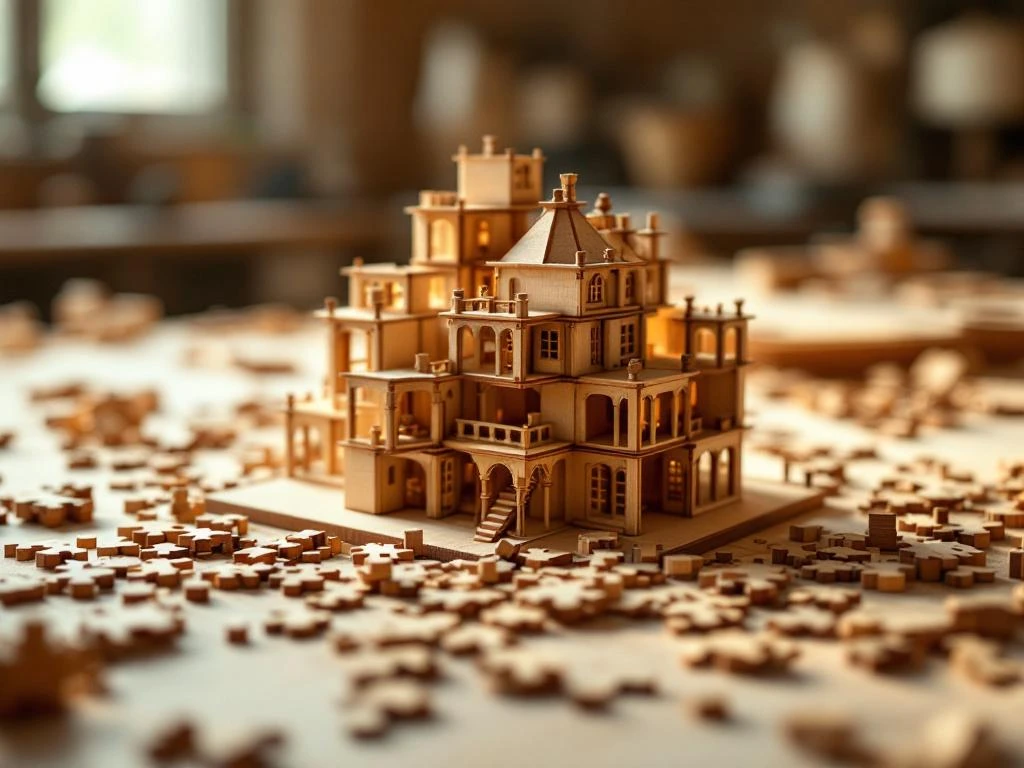
This three-dimensional thinking is essential for many daily activities, from packing a suitcase to understanding architectural plans. Wooden 3D puzzles, for example, such as detailed models of famous buildings, help develop this crucial spatial insight by building complex structures step by step.
The difference from jigsaw puzzles is significant: where with a jigsaw puzzle you only need to match what you see on a flat surface, with 3D puzzles you must think ahead about how components connect in space and what impact each choice has on the overall structure.
2: Refined motor skills through more complex actions
3D puzzles require much more precise hand-eye coordination than their flat counterparts. Manipulating puzzle pieces in different directions, making connections at various angles, and stabilizing structures during construction: everything contributes to the development of fine motor skills.
These more complex actions are especially valuable for children in their developmental phase, but adults also benefit from this motor training. The difference from jigsaw puzzles is that you don’t just place pieces next to each other, but must also work above, below, and around existing components.
3D building sets and model construction take this a step further by using different materials and connection methods, making the motor challenge even more diverse and training different muscle groups in hands and fingers.
3: Long-lasting motivation through tangible end result
Perhaps the most satisfying aspect of 3D puzzles is the tangible end result that you can keep, display, or even use as a functional object. While jigsaw puzzles are often stored away or taken apart after completion, 3D puzzles remain a lasting reminder of your achievement.
This long-term visibility of your work provides much stronger motivation to complete puzzles. The prospect of a beautiful decorative object or an interesting conversation piece motivates puzzlers to persevere, even when they encounter challenging parts.
Additionally, many 3D puzzles can be functional – think of puzzle boxes, lamps, or architectural models that can serve as educational tools. These practical applications give puzzling an extra dimension that traditional jigsaw puzzles lack.
4: Developing better problem-solving skills
3D puzzles offer more complex logical challenges because they work with multiple dimensions and connection options simultaneously. This increased complexity stimulates critical thinking and strategic planning at a level that jigsaw puzzles rarely achieve.
With a 3D puzzle, you must not only figure out which piece fits where, but also in what order you should assemble components to maintain access to all necessary connection points. This forward-looking perspective and strategic planning are valuable skills that are applicable in many other life situations.
Solving these three-dimensional challenges also strengthens perseverance and frustration tolerance, because the solutions are often less obvious than with traditional puzzles.
5: Stimulating social interaction and collaboration
3D puzzles naturally invite collaboration and social interaction in a way that jigsaw puzzles cannot match. Because the puzzle is three-dimensional, multiple people can work simultaneously on different sides without getting in each other’s way.
This natural division of tasks makes 3D puzzles ideal for family activities or team building. Different people can specialize in different aspects of construction, such as sorting components, assembling subsections, or coordinating overall construction.
The communication required to successfully collaborate on a 3D puzzle – explaining spatial concepts, coordinating actions, sharing strategies – promotes social skills in a natural and enjoyable way.
6: Which age groups benefit most from 3D puzzles?
3D puzzles are particularly suitable for a wide range of age groups, but offer specific benefits for different developmental phases. Children from about eight years old begin to understand the spatial concepts needed for 3D puzzles, while the motor challenge perfectly matches their developing skills.
Teenagers especially benefit from the strategic planning aspects and the satisfaction of creating complex structures. For adults, 3D puzzles offer an excellent way to reduce stress while keeping cognitive functions sharp.
Seniors find in 3D puzzles an ideal combination of mental stimulation and motor exercise, which can help maintain cognitive flexibility and manual dexterity. Unlike jigsaw puzzles, which are sometimes perceived as too simple by certain age groups, 3D puzzles offer appropriate challenges for every age.
7: Sustainability and reusability as an advantage
3D puzzles significantly surpass jigsaw puzzles in terms of sustainability and reusability. Where jigsaw puzzles often show wear on the cardboard pieces after repeated use, 3D puzzles are usually made from sturdier materials that can withstand multiple assembly cycles.
The ability to take apart and rebuild 3D puzzles gives them a much longer lifespan. This makes them not only more economically advantageous in the long term, but also more environmentally friendly through their reusability.
Many 3D puzzles can also be modified or combined with other sets, further increasing their play value. This flexibility and durability make 3D puzzles an investment that lasts for years, unlike jigsaw puzzles that often provide the full experience only once.
8: Educational value and knowledge transfer
The educational value of 3D puzzles goes far beyond what traditional jigsaw puzzles can offer. By building three-dimensional models of historical buildings, mechanical constructions, or natural structures, 3D puzzles make abstract learning concrete and tangible.
Subjects like architecture, mechanics, history, and even biology become much more understandable when they can be experienced in three-dimensional form. A 3D puzzle of a cathedral teaches more about Gothic architecture than any flat image could.
This hands-on learning experience perfectly aligns with different learning styles and makes complex concepts accessible to a broad audience. The combination of visual, tactile, and logical learning makes 3D puzzles powerful educational tools that traditional puzzles simply cannot match.
Make the switch to high-quality 3D puzzles
The advantages of 3D puzzles over traditional jigsaw puzzles are clear: from improved cognitive development to long-lasting motivation and educational value. These three-dimensional challenges offer a richer, more satisfying puzzle experience that is suitable for all ages and skill levels.
When choosing your first 3D puzzle, it’s important to start with a complexity that matches your experience. Beginners should start with simpler models to become familiar with three-dimensional thinking, while experienced puzzlers can immediately switch to more challenging 3D puzzles that truly test their skills.
Whether you choose educational architectural models, mechanical constructions, or artistic sculptures: the world of 3D puzzles offers endless possibilities for learning, growing, and enjoying. Which three-dimensional challenge will you tackle first?
Frequently Asked Questions
How do I choose the right difficulty level for my first 3D puzzle?
Start with puzzles of 50-100 pieces if you're new to 3D puzzles. Look at the age recommendation on the packaging and choose something that's 1-2 years above your comfort zone. Architectural models like simple towers or houses are ideal for beginners because they have clear structures.
What do I do if my 3D puzzle collapses or falls apart during construction?
This is normal during the learning process. Build step by step and make sure each connection is secure before continuing. Use the instructions to check if you're following the correct sequence - often the assembly order is crucial for stability. Be patient and see it as part of the learning process.
Are 3D puzzles suitable for children with concentration problems or ADHD?
Yes, 3D puzzles can actually help improve concentration because they provide tangible, direct feedback. The three-dimensional aspects hold attention and the tangible end result motivates persistence. Start with shorter sessions of 15-20 minutes and choose puzzles with clear, colorful components.
Can I reuse 3D puzzles and are they worth the money compared to jigsaw puzzles?
Absolutely! 3D puzzles can be taken apart and rebuilt multiple times without wear. They also serve as decoration between puzzling sessions. Although the initial investment is higher than jigsaw puzzles, the price per use is often lower due to their durability and reusability.
What materials are best for 3D puzzles and what should I look for when purchasing?
Wooden 3D puzzles offer the best durability and a premium feel, while plastic puzzles often have more detail and color. Look for sturdy connections, clear instructions, and good reviews. Avoid puzzles with pieces that are too small if you're working with young children, and check that all components fit well without being forced.
How long does it take on average to complete a 3D puzzle?
This varies greatly depending on complexity and experience. Simple 3D puzzles (50-100 pieces) take 1-3 hours, while complex models (500+ components) can take 8-20 hours. Beginners often need 2-3 times longer than experienced puzzlers. Plan multiple sessions instead of trying to finish everything at once.
What are the best strategies to prevent frustration during 3D puzzling?
Sort all components beforehand by color or shape, read the instructions completely before starting, and take regular breaks. Begin with the base or corner pieces and work systematically upward. If you get stuck, put the puzzle away and come back to it later - often you'll see the solution immediately.
Table of contents
Much viewed
More blogs