
-
 Dave Vinke
- Leestijd: 5 min
- Laatst geüpdatet: 04/01/2026

Did you know that the brains of children under 10 years old are still actively developing? This is the perfect time to stimulate their cognitive skills with challenging and fun brain teasers. Puzzles and brain games are much more than just toys; they are powerful tools that help develop problem-solving thinking, concentration, and self-confidence.
As a parent, you naturally want the best for your child, but with so many different brain teasers on the market, it can be difficult to make the right choice. Which puzzles suit your child’s age? And how do you know if a brain teaser isn’t too easy or too difficult?
In this article, you’ll discover five fantastic brain teasers that are perfect for children under 10 years old. From classic puzzles to modern magnetic building sets: each game contributes in its own way to your child’s development.
Why brain teasers are essential for young children
Brain teasers are much more than just a pastime. They play a crucial role in the cognitive development of young children. When children solve puzzles, they actively train their problem-solving thinking. They learn to think step by step, consider different possibilities, and come up with creative solutions.
Spatial insight is enormously stimulated by brain teasers. Children learn how shapes fit together, how objects relate to each other in space, and develop a better understanding of dimensions and perspectives. These skills come in handy later in subjects like mathematics and physics.
Additionally, brain teasers improve concentration and perseverance. Children learn to stay focused, even when a puzzle becomes challenging. This greatly increases their self-confidence when they eventually find the solution. Fine motor skills are also trained by handling small puzzle pieces, which is important for writing skills.
1: Rubik’s Cube 2×2 – the perfect first speedcube
The 2×2 Rubik’s Cube is an excellent choice for children who want to take their first steps into the world of speedcubing. Unlike the traditional 3×3 Cube, this smaller version has only eight corner pieces, making it much more manageable for beginning puzzlers.
What makes this brain teaser so suitable for children under 10 is that the algorithms are much simpler to learn. Where a 3×3 Cube sometimes requires complex movement sequences, children can often solve the 2×2 version with just a few basic algorithms. This ensures they gain successful experiences faster and stay motivated to continue practicing.
The faster solving time is a major advantage. While a 3×3 Cube for beginners can often take 10-15 minutes, children can usually solve a 2×2 Cube within 5 minutes once they have mastered the basics. This keeps their attention and prevents frustration. Moreover, they can gradually expand their skills to more complex Cubes when they are ready.
2: Tangram puzzles – creativity and spatial thinking
Tangram puzzles are among the most versatile brain teasers for children. These ancient Chinese puzzles consist of seven geometric shapes that together form a square. The special thing about tangrams is that children can both make predetermined figures with them and come up with their own creative designs.
Spatial insight is developed in a playful way as children must visualize how different shapes can together form a larger whole. They learn about angles, symmetry, and proportions without it feeling like a math lesson. These skills are invaluable later in technical subjects.
Tangram puzzles are available in different difficulty levels. Beginners can start with simple shapes like houses or boats, while advanced puzzlers can try more complex figures like animals or people. The beautiful thing is that children can also create their own challenges by inventing figures themselves and challenging friends to recreate them. This stimulates both creativity and problem-solving ability.
3: Wooden patience games – motor skills and perseverance
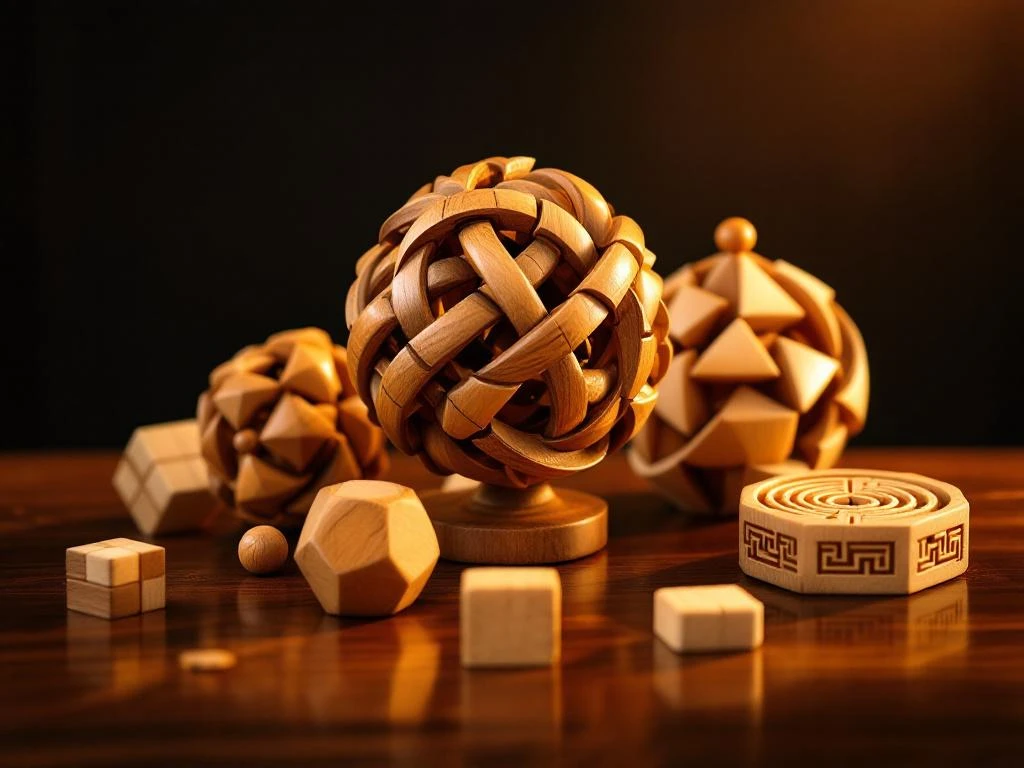
Classic wooden brain teasers like the snake cube, star game, and other mechanical puzzles have a timeless charm. These tactile puzzles offer a welcome change from digital stimuli and help children focus completely on the problem before them.
Fine motor skills are intensively trained as children must precisely maneuver the wooden components. Every movement must be deliberate, which improves hand-eye coordination. This is especially important for children who are still developing their writing skills.
Wooden patience games teach children to work methodically. They can’t just randomly try puzzle pieces but must think step by step about each move. This develops their ability to approach problems systematically. When an attempt doesn’t work, they must patiently start over. This experience builds perseverance that will serve them well later in life in challenging situations.
4: Which age fits which difficulty level?
Choosing the right difficulty level is crucial for your child’s success with brain teasers. Puzzles that are too easy quickly become boring, while puzzles that are too difficult can lead to frustration and giving up the hobby.
For children aged 6-7 years, simple tangrams, large wooden puzzles, and simple shape recognition games are ideal. Their attention span is still relatively short, so puzzles that can be solved within 10-15 minutes are perfect. Think of puzzles with large pieces that are easy to grasp.
Children aged 8-9 years can start with more complex challenges. The 2×2 Rubik’s Cube now becomes interesting, as well as tangrams with more detailed figures. They can also start with simple wooden patience games that require a bit more time and patience. Their problem-solving ability is now sufficiently developed for multi-step puzzles.
For children aged 9-10 years, many more possibilities open up. They can start with the traditional 3×3 Rubik’s Cube, more complex magnetic building puzzles, and challenging wooden brain teasers. Their perseverance is now strong enough to tackle puzzles that can sometimes take an hour or more.
5: Magnetic building puzzles – 3D thinking and construction
Magnetic building puzzles represent a modern evolution in the world of brain teasers. These innovative puzzles combine the challenge of traditional puzzles with the fascination of magnetism, offering children a unique and engaging experience.
3D spatial thinking is intensively stimulated as children must visualize how flat magnetic pieces can fold into three-dimensional structures. They learn about geometry, stability, and construction principles in a hands-on way. These skills are valuable for future studies in engineering, architecture, and design.
Safety is naturally an important consideration with magnetic toys. High-quality magnetic building puzzles are designed with strong, encapsulated magnets that cannot come loose. Always check that the toy meets European safety standards and is suitable for your child’s age. The educational value is enormous: children learn about magnetic forces, symmetry, and structural engineering while playing. Moreover, they can easily modify their creations and try new designs thanks to the reusable magnetic connections.
Choose the right brain teaser for your child
Selecting the perfect brain teaser for your child requires attention to various factors. Observe what your child is interested in: if they love colors and patterns, then Rubik’s Cubes might be perfect. If your child is more visually oriented and enjoys drawing, then tangram puzzles might be a better choice.
Pay close attention to your child’s current skill level. Always start slightly below the suspected level to build confidence and gradually work toward more complex challenges. Motivation is more important than the speed of progression. Celebrate small victories and encourage your child to persevere when a puzzle becomes challenging.
For parents looking for quality brain teasers, it’s important to choose reliable suppliers who specialize in educational puzzle material. Look for stores that provide clear product descriptions, mention age recommendations, and offer good customer service. In the extensive assortment of brain teasers, you’ll find puzzles for every age group and skill level, from beginning puzzlers to experienced cubers.
Which brain teaser will you try first with your child? Remember that the most important goal is to have fun together and help your child grow in confidence and problem-solving ability.
Frequently Asked Questions
How long should my child work with brain teasers per day?
For children under 10 years old, 15-30 minutes per day is ideal. Young children have a shorter attention span, so multiple short sessions work better than one long session. Pay special attention to signs of fatigue or frustration and stop in time to keep the experience positive.
What should I do if my child gets frustrated with a difficult puzzle?
Take a break and return to the puzzle later. Help your child by solving the puzzle together or by giving hints instead of showing the solution. Teach your child that getting stuck is normal and part of the learning process. Consider temporarily offering an easier puzzle to restore confidence.
Can brain teasers also help with school performance?
Yes, absolutely! Brain teasers improve problem-solving thinking, concentration, and perseverance - skills that are directly applicable to mathematics, physics, and other subjects. The spatial insight developed through puzzles especially helps with geometry and technical subjects. Many parents notice that their children become better at systematic work after regular puzzling.
Is it normal that my child initially only wants to do the easiest puzzles?
Absolutely normal and even recommended! Children build confidence by experiencing successes. Let your child take the time to master a puzzle level well before moving to more difficult challenges. Gradual progression ensures more fun and less frustration than scaling up too quickly.
What brands or quality features should I look for when buying brain teasers?
Look for CE marking for safety, sturdy materials that don't break easily, and clear age indication. With magnetic puzzles, check that the magnets are well encapsulated. Choose brands with good reviews and avoid extremely cheap alternatives that are often of lesser quality. Wooden puzzles should be smoothly finished without splinters.
How can I motivate my child to continue when a puzzle seems too difficult?
Break the puzzle into smaller steps and celebrate every small progress. Show interest in the process, not just the end result. Sometimes puzzle together and let your child 'help' you with difficult parts. Use a reward system for perseverance, not just for solving the puzzle. Remind your child of previous puzzles that also seemed difficult at first.
From what age can my child start speedcubing?
Most children can start with a 2x2 Rubik's Cube from 7-8 years old and learn simple algorithms. For serious speedcubing (speed solving), 9-10 years is usually a good starting age, when fine motor skills and memory are sufficiently developed. Always start with having fun, the speed will come naturally later.
Table of contents
Much viewed

More blogs